Figure · 1740 to 1814
The Marquis de Sade: The Man Behind the Adjective
By Marguerite Osei, Biographies Published 31 August 2026 Updated 31 August 2026
In brief
Donatien Alphonse François, Marquis de Sade, was a French aristocrat and novelist who spent roughly three decades of his life in prisons and asylums, much of it without a criminal conviction. He wrote The 120 Days of Sodom in the Bastille in 1785 and published Justine anonymously in 1791. His surname became a French byword for cruelty within a generation of his death and a clinical diagnosis by 1886, a use he neither chose nor could have anticipated.
Two people are usually confused under this name. There is the adjective, which means cruelty for its own sake and is applied to dictators and schoolteachers. And there is the man, an eighteenth-century French nobleman with a short military career, a difficult marriage, a talent for making enemies, and a body of writing that almost nobody has read to the end. The adjective has been more useful to more people, and it has almost entirely replaced the man.
The life, in outline
He was born in Paris in June 1740 into an old Provençal family, served in the Seven Years’ War, and married Renée-Pélagie de Montreuil in 1763. The marriage was arranged and the alliance mattered, since it brought him into a family with the connections to protect him and, later, the motive to destroy him.
Complaints began almost immediately. A woman named Jeanne Testard made one in the autumn of 1763 and he was briefly imprisoned. In 1768 a widow called Rose Keller went to the authorities with an account of being confined and beaten at his house at Arcueil; he gave a different version, the family paid, and the case was extinguished. In 1772 he and his valet were charged after an incident in Marseille involving prostitutes and a preparation given to them as sweets. Two of the women fell ill. Sade and the valet fled, were sentenced to death in absentia and burned in effigy, and the sentence was set aside six years later. In the winter of 1774 the families of servants engaged at his estate at La Coste complained of what had happened there, and again the matter was settled with money.
His mother-in-law then obtained a lettre de cachet, a royal warrant permitting imprisonment without trial, and from 1777 he was held at Vincennes and then, from 1784, in the Bastille. He was transferred to the asylum at Charenton days before the prison fell in July 1789 and released the following spring when the Revolution abolished the warrants that held him.
The Revolution did not save him for long. He held minor office in his Paris section, wrote political pamphlets, was imprisoned in 1793 as a suspect and escaped the guillotine largely by accident. In 1801 Napoleon’s police arrested him over his novels, and he was moved through two prisons to Charenton, where he remained without trial until his death in December 1814. Biographers note that he staged theatricals there using the other inmates.
What he was and what he was not

The record above is the reason the romantic reading of Sade as a martyr to free expression does not survive contact with the sources. He was imprisoned without trial, which was an injustice, and he had also given real people real cause for complaint. Both are true. The aristocratic system that confined him for decades is the same system that kept him out of an ordinary courtroom every time an ordinary prosecution threatened.
It is equally wrong to read his fiction as a record of his conduct. What he was accused of, in the documented cases, is at a considerable distance from what he wrote. The books are not a confession, and the man’s crimes do not need the books to be serious.
What the books argue
The 120 Days of Sodom was written in the Bastille in 1785 on a long roll of paper he kept hidden. He believed it destroyed when the prison was stormed; it survived, passed through private hands for more than a century, was first published in 1904, and eventually returned to a French national collection.
Its subject, and the subject of Justine in 1791 and Juliette at the end of the decade, is an argument rather than a scenario. Sade’s libertines assert that nature is indifferent, that virtue is not rewarded, that law and religion are conveniences maintained by the powerful, and that the strong are under no obligation they have not consented to. The fiction exists to demonstrate the argument by exhausting it. There is no negotiation in it, no consent, no limit and no reciprocity. The victims are chosen for their powerlessness and most of them are killed.
This matters for the history that followed. The practices the nineteenth century came to call sadism have very little to do with the content of these books, which describe atrocity rather than exchange. The word carried the association anyway.
The name he did not choose
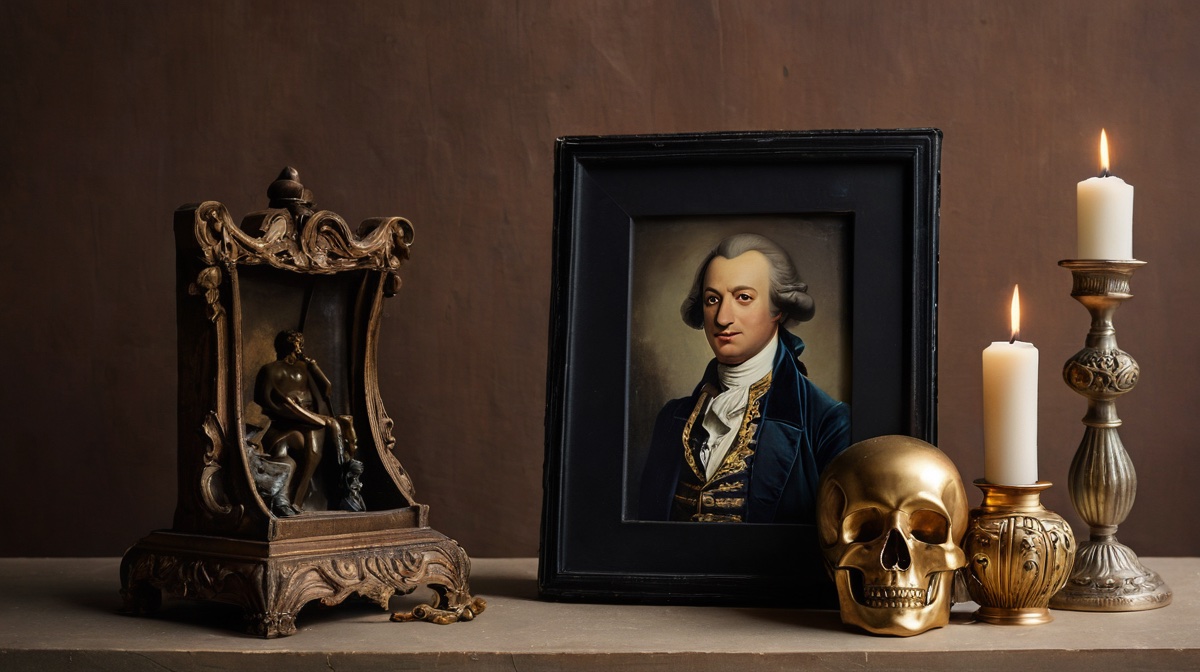
Sadisme was current in French well before medicine reached for it, and lexicographers were recording it in the 1830s. Krafft-Ebing adopted the existing word as a diagnosis in 1886, which is how a novelist’s surname ended up as a category in psychiatric manuals for the next hundred and twenty years. The other half of the pair, Leopold von Sacher-Masoch, was alive and publishing when his own name was taken, which makes Sade the luckier of the two by a margin of seventy-two years. The route from the name to the diagnosis is set out separately, as is the psychiatrist who filed it.
The cost is straightforward. A man who wrote several thousand pages of political and philosophical fiction survives as one syllable in a clinical term, and the term describes something his books do not. For the world he was writing in and against, see the period before 1800.
This page is assembled from published biographies and the notes at the back of them, period magazines and newspapers, the minutes, newsletters and membership records that organisations left behind, court reports and published judgments, and academic histories of sexuality. Dates and events are taken from that documentary record rather than from what the subculture repeats about itself, and the two often disagree. Where the record is thin, where it survives only through a single interested witness, or where historians still argue about what happened, the page says so in the text instead of smoothing it over.
Questions readers ask
What was the Marquis de Sade actually convicted of?
Very little, which is one of the odder features of his case. He was sentenced to death in his absence in 1772 for poisoning and sodomy after an incident in Marseille, and that sentence was annulled six years later. Most of his imprisonment was administrative rather than judicial, imposed by royal warrant at his mother-in-law's instigation, and later by Napoleon's government without trial. The same aristocratic machinery that locked him up also shielded him from the courts.
Did the Marquis de Sade hurt real people?
Yes. Complaints were made against him by Jeanne Testard in 1763, by Rose Keller in 1768, by four women in Marseille in 1772, and by the families of servants employed at his estate in the winter of 1774. He disputed elements of several accounts and money changed hands to make the cases go away. The pattern of complaints is documented and the people who made them were real, and no account of his life is honest without that.
Is sadism named after the Marquis de Sade?
Yes, but not by a doctor. The French noun sadisme was already in circulation and being entered by lexicographers in the 1830s, decades before medicine adopted it. Krafft-Ebing took an existing popular word and gave it a clinical definition in 1886. Sade himself never used it and had been dead for over seventy years.
Every name here started by finding other people
Letters, small-circulation magazines, back rooms, mailing lists. The channel changes every generation and the reason for it never does.
See where it happens now