Topic · Objects
The Leather Pride Flag: A Symbol Its Designer Refused to Explain
By Niall Brannagh, Law, language and community Published 22 July 2026 Updated 22 July 2026
In brief
The leather pride flag was designed by Tony DeBlase and first shown at International Mr Leather in Chicago in May 1989. It has nine horizontal stripes alternating black and royal blue, with a white stripe across the centre and a red heart in the upper left corner. DeBlase deliberately declined to assign meanings to the elements, leaving interpretation to whoever looked at it, and the colour meanings now widely repeated were attached by other people afterwards.
Flags for communities are usually designed by committee and explained at length. This one was designed by a single person, presented without an explanation, and released without conditions, and it has outlasted a great many symbols that came with instructions.
The design
Nine horizontal stripes of equal width, alternating black and royal blue, with the middle stripe white, and a large red heart in the upper left corner. It is a straightforward flag by the standards of flag design: high contrast, few elements, recognisable at distance and reproducible by anyone with two colours of fabric.
The visual grammar was borrowed by almost everything that followed. The rubber, bear, pup and other community flags produced from the 1990s onward mostly use the same structure of horizontal bands plus a corner emblem, which is a measure of how thoroughly this one established the format.
Chicago, 1989

Tony DeBlase unveiled it at International Mr Leather in Chicago in May 1989. The venue was not incidental. IML, running since 1979 and described in the era essay for 1970 to 1989, was the one occasion in the year when the leather community assembled in a single place from across the country and beyond. A symbol shown there reached the whole constituency in a weekend.
DeBlase was well placed to be listened to. He ran Drummer, the leather world’s main magazine, and two years later he co-founded the Leather Archives and Museum in Chicago, one of the institutions covered in the history of BDSM organisations. He was, in other words, a publisher and an archivist rather than an artist, which may explain the design’s plainness and certainly explains its distribution.
The meaning he declined to give
The unusual part is what he did not do. Presenting the design, DeBlase declined to state what the colours or the heart stood for, and said the interpretation was for the people who looked at it. He did not register it, license it or set rules for its use.
That was a decision with consequences. The leather community in 1989 was not one thing: gay men, lesbians, heterosexual practitioners, motorcycle clubs, contest circuits, sadomasochists who did not wear leather and leathermen who were not sadomasochists. Any explicit definition would have written someone out. An unexplained flag included everyone by declining to specify anyone.
The colour meanings now recited as standard, black for leather, blue for denim, white for purity, the heart for love, arrived later and from nobody in particular. They are retrospective folk readings of an open symbol, and while there is nothing wrong with them, they are not what the flag was given as, and sources that present them as the designer’s intention are mistaken.
Adoption
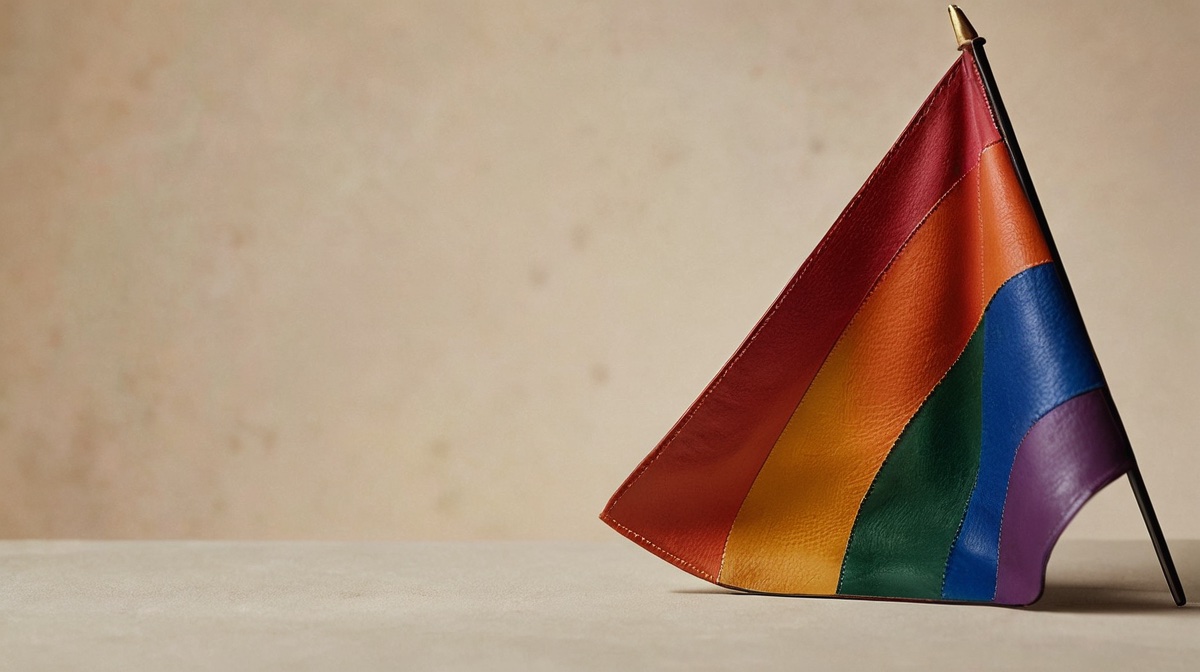
Take-up was fast. Clubs adopted it, contests flew it, vendors printed it, and within a few years it was the recognised emblem of the leather world in North America and Europe. It was quickly adopted by events that predated it, including the San Francisco street fair that had been running in the city’s leather district since 1984, which gave the design an appearance of having always been there.
Timing helped. The flag arrived in the middle of the AIDS epidemic, at a point when the community was burying people constantly and had a pressing need for something to carry at a memorial or a march. A symbol that means whatever the person holding it needs it to mean is well suited to that use.
It also solved, in one image, a problem that the culture had been addressing piecemeal for two decades with the signalling conventions described in the history of the hanky code. Those were private codes, legible only to people who already knew them, developed in the bar culture of the postwar decades when discretion was necessary. The flag is the opposite: a public claim, readable by anyone, and a sign that a community that had signalled sideways for thirty years was now prepared to be seen.
Its later career has been contested in ways DeBlase could not have anticipated. The flag turns up in arguments about what belongs at Pride, on merchandise sold by companies with no connection to any of this, and in places where its history is unknown to almost everyone present. An open symbol cannot object to its own use, which is the cost of designing one and, on the whole, the point of it.
This page is assembled from published biographies and the notes at the back of them, period magazines and newspapers, the minutes, newsletters and membership records that organisations left behind, court reports and published judgments, and academic histories of sexuality. Dates and events are taken from that documentary record rather than from what the subculture repeats about itself, and the two often disagree. Where the record is thin, where it survives only through a single interested witness, or where historians still argue about what happened, the page says so in the text instead of smoothing it over.
Questions readers ask
What do the colours of the leather flag mean?
Officially, nothing. Tony DeBlase declined to fix a meaning when he presented the design in 1989 and said the interpretation belonged to the viewer. The explanations in general circulation, black for leather, blue for denim or devotion, white for purity, the heart for love, were supplied later by other people and have no authority behind them beyond repetition. They are folk readings of a deliberately open symbol.
Who designed the leather pride flag?
Tony DeBlase, a publisher and community figure who ran Drummer magazine in the late 1980s and went on to co-found the Leather Archives and Museum in Chicago in 1991. He unveiled the flag at International Mr Leather in May 1989 and placed no restrictions on its use. He died in 2000.
When was the leather flag first flown?
At International Mr Leather in Chicago in May 1989, the leather community's largest annual gathering and therefore the one place where a new symbol could reach the whole constituency at once. Adoption was rapid: clubs, contests and vendors picked it up within a few years, and by the mid-1990s it was the recognised emblem of the leather world.
This thread has not been cut
Law, language and community argument all keep moving, and the people moving them are in the same rooms as everyone else.
See where it happens now